Renter-Friendly DIY
Renter-Friendly DIY: Questions to Ask Before You Start
The questions to work through before any damage-free upgrade in a rented home, with links to official guidance.
General guidance, not legal advice. Tenancy rules differ between England, Wales, Scotland and Northern Ireland, and between individual agreements. If you're unsure about your rights, check the official guidance linked below or get independent advice.
Small changes can make a rented home work much better, but they can also lead to disputes over damage or deposits. Working through these questions before you start helps you choose something reversible and avoid surprises when you move out.
What does your tenancy agreement say?
Read the sections on alterations, decorating, fixtures, damage and the end of the tenancy. Some agreements say you need the landlord's consent before making changes; others are silent. Keep a copy of your agreement and any inventory or check-in report, as these are usually what condition is compared against when you leave.
Where to find official guidance
- England: GOV.UK's private renting guidance, the How to Rent guide and the Renters' Rights Act overview for tenants.
- Wales: Welsh Government guidance on Renting Homes, which explains occupation contracts.
- Scotland: mygov.scot renting guidance, including information on private residential tenancies.
- Northern Ireland: nidirect guidance on problems in private rented housing.
Free independent advice is available from organisations such as Citizens Advice and Shelter (England and Scotland) or Housing Advice NI.
Should you ask permission in writing?
If your agreement requires consent, or you're not sure, ask your landlord or letting agent before you start. Email is usually easiest because it gives you a dated record. Describe what you want to do, where, which product or fixing you plan to use and how you'll remove it. Keep the reply with your tenancy paperwork.
Could a reversible option do the job?
Often the simplest approach needs no fixings at all:
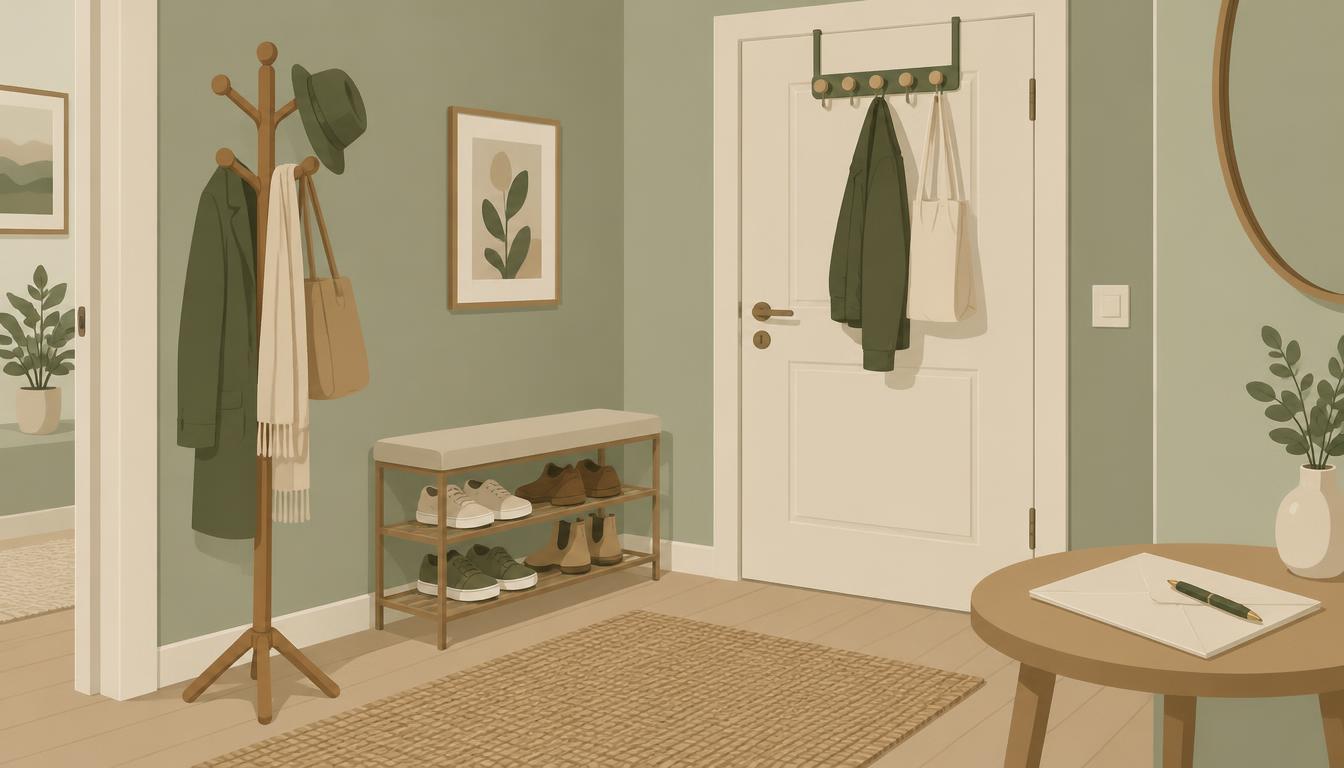
- Freestanding shelves, coat stands and shoe benches.
- Over-door hooks and racks, where the door still closes properly.
- Tension rods within the length and load the manufacturer states.
- Storage that fits inside existing cupboards and wardrobes.
See vertical storage ideas for tiny rooms for more freestanding options. For bedrooms, freestanding under-bed storage needs no fixings at all.
What surface are you working with?
Painted plaster, plasterboard, tiles, wood, wallpaper and textured paint all behave differently. Adhesive strips and hooks are usually designed for particular surfaces and may lift paint or wallpaper when removed, especially from fresh paint or uneven finishes. Check the packaging for suitable surfaces, temperature and humidity limits and how long to wait before loading. If in doubt, ask your landlord or test in an inconspicuous spot only with permission.
Are you within the weight limit?
Every hook, strip, rod and shelf has a maximum load stated by the manufacturer. Stay within it, allow for things that get heavier (such as damp towels or a full bag), and don't combine products in ways the instructions don't cover. If something needs screws or wall plugs, follow the manufacturer's fixing instructions — and get permission first.
Could tall furniture tip over?
Tall or top-heavy furniture such as bookcases and chests of drawers can tip if climbed on or overloaded, which is a particular risk with young children. Many manufacturers supply anti-tip fittings that fix to the wall. In a rented home, ask your landlord about fitting them, keep heavy items on lower shelves and never let children climb units. The Royal Society for the Prevention of Accidents publishes home-safety advice.
Will it protect floors, surfaces and ventilation?
- Use felt pads or mats under freestanding furniture to avoid marking floors.
- Don't block radiators, air bricks, trickle vents, extractor fans or windows.
- Leave a gap between furniture and outside walls so air can circulate, which can help reduce condensation.
- Report damp, mould or disrepair to your landlord in writing rather than covering it up.
How will it come off when you move out?
Keep instructions for any removable product, as many need a particular removal technique. Note what you added and where, and plan to remove it before your check-out inspection unless your landlord has agreed in writing that it can stay. If something leaves a mark, check your agreement and speak to your landlord about how it should be put right.
Before you start: a quick checklist
- I've read my agreement's sections on alterations and damage.
- I've asked for written permission where needed.
- I've considered a freestanding or no-fixing option.
- The product suits my surface and conditions.
- The load is within the manufacturer's limit.
- Tall furniture is stable and tip risks are dealt with.
- Nothing blocks heating or ventilation.
- I've kept the removal instructions and a note of what I added.
Explore more renter-friendly DIY ideas, or use our room measurement worksheet to plan what will fit.
Make Room for What Matters
Download the free 7-day small-space decluttering checklist — no email address needed.